

White Papers
Trust the data beneath the answer

More compute doesn't fix data you can't see.
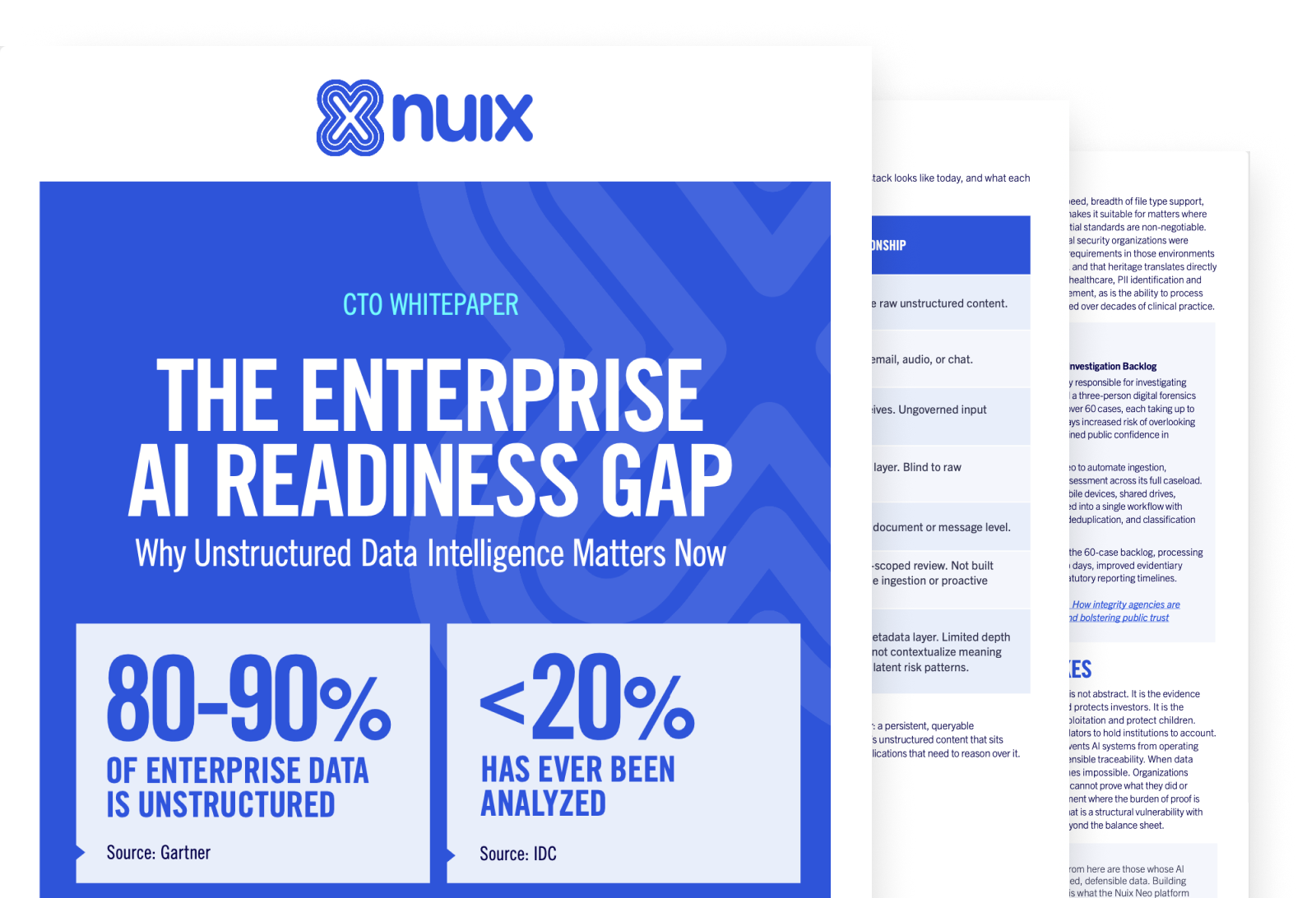
Your AI is only as good as the data it can see, and most of your enterprise data, it can't. Nuix CTO Alexis Rouch breaks down the visibility gap behind every unreliable AI output, and what it takes to close it.
Twelve months ago, the question most enterprise data teams were asking was whether to deploy AI. Today they're asking why it isn't working. The cause is consistent across sectors and geographies: the data the AI systems need is opaque.
Between 80 and 90% of enterprise data is unstructured: emails, contracts, chat histories, call transcripts, audio recordings, mobile captures. Less than a fifth of it has ever been analyzed. Every AI agent in the organization is working on a fraction of the real picture.
The risk isn't that the AI will fail obviously. The risk is that it will perform well enough on the data it can see, and nobody will know what it missed.
"Every enterprise we work with is asking the same question: how do we get AI operating on the data where our actual risk and insight lives? The answer starts with making that data visible and governable."
— Alexis Rouch, Chief Technology Officer, Nuix
What's in the Report
The Context Layer, Defined
Why semantic layers solve this for structured data but do nothing for unstructured content, and what closes the gap.
Where Your Stack Already Fails
A breakdown of Lakehouses, BI tools, governance platforms, and where each one goes blind on unstructured data.
The Token Economics Case
Why ungoverned input to LLMs is a structural cost problem, not just a quality one, with real reduction figures.
Case Studies From Live Deployments
A prosecutor's office, a government integrity agency, and the outcomes when the backlog finally clears.